

Disclaimer: I used Claude to analyze my Fitbit and Garmin sleep data and assist with writing this post.
I started taking Magnesium L-Threonate in February 2025 after reading about its supposed sleep benefits. I have two young kids and my sleep has been a mess for years, so I figured it was worth a shot.
Magnesium L-Threonate is designed to support brain health, cognitive performance, and restorative sleep by increasing magnesium levels in the brain.
I take magnesium from Momentous. At ~$50 per month (or $37.46 if you sign up for a monthly subscription), it’s not cheap, but it’s NSF Certified for Sport, “a respected independent program that verifies label accuracy and screens for hundreds of banned substances.” Given I put it into my body every day, the cost is worth it to avoid junk and ensure I’m actually getting what I’m paying for.
I’ve been wearing a Fitbit since late 2019 and switched to a Garmin Vivoactive 5 in late 2024 — so I had 1,198 nights of Fitbit data and 527 nights of Garmin data to work with. That’s over 1,700 tracked nights, spanning pre-kids, two newborn phases, and now 16 months of magnesium supplementation totaling roughly $696.86. (Ouch - writing this article is the first time I’ve totaled up the cost!)
Here’s what I found.
The Verdict
Given two kids and six years of constant, interrupted sleep, it’s tough to know for sure whether magnesium is helping. I generally wake up feeling well rested, though my focus on health/fitness over the past two years is a positive influence too: weight training, biking, eating very healthy, and purposely aiming for better sleep.
I’ve decided to continue supplementation, especially because I’m curious to review the metrics once Child 2 sleeps through the night consistently. Given the high monthly cost though, I’ll shop around for other NSF-certified brands.
I do want to pause at some point to see what happens. Claude suggested March or April:
That gets you off-ramp past the winter dip, gives you a clean spring/summer window when your baseline is historically stable (your Fitbit shows consistent 81–84 in Apr–Aug across multiple years), and lets you restart in August or September before the next seasonal drop. A May restart would be too soon; a September restart aligns with roughly 5 months off, which is meaningful.
The Setup
A few key dates that matter for all of this:
Child 1 born: October 2020
Child 2 born: October 2023
Switched from Fitbit to Garmin: December 2024
Started Magnesium L-Threonate: February 13, 2025
One important caveat upfront: Fitbit and Garmin use different scoring algorithms. Fitbit scores cap around 91; Garmin goes up to 99. In stable periods, my Garmin scores run about 3 points higher than my Fitbit scores would for equivalent sleep. I’ve adjusted for this in the child-comparison charts, but the overall timeline chart shows raw scores — so the two devices aren’t directly comparable there.
The Big Picture: 5.5 Years of Sleep
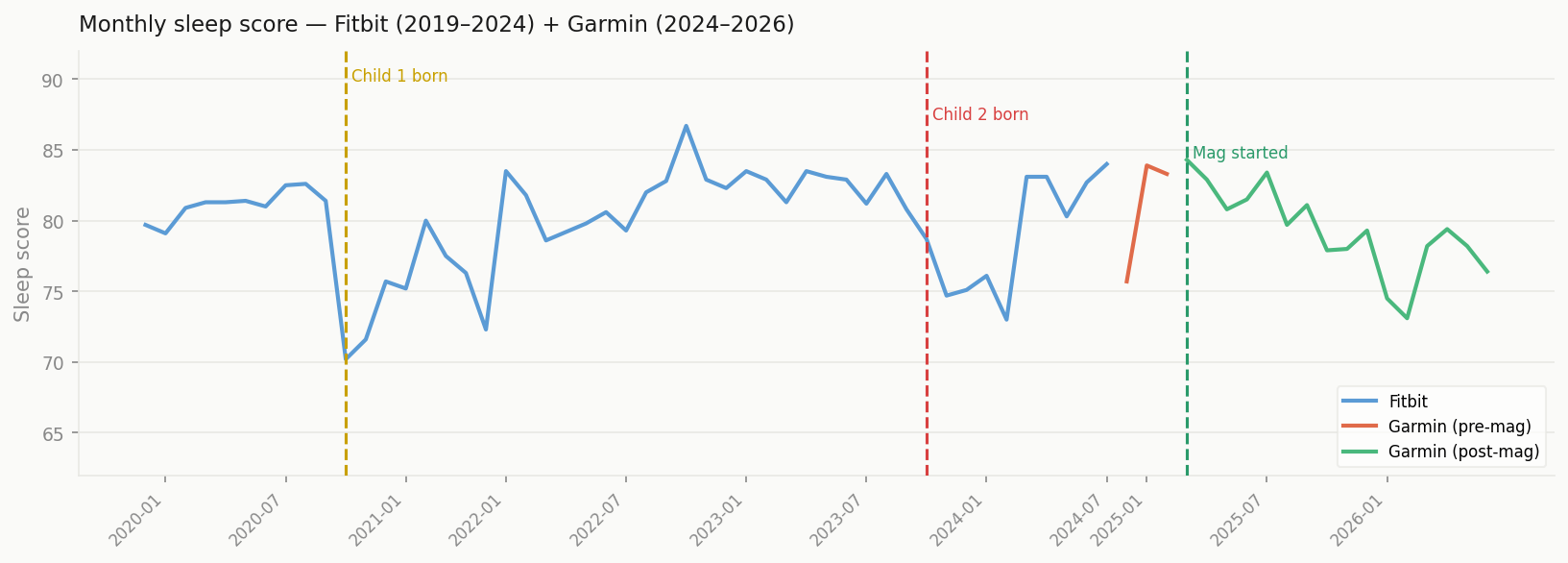
A few things jump out immediately:
The Child 1 impact was dramatic — scores dropped from around 81 to the low 70s in October–November 2020, then took over a year to recover. The Child 2 impact in October 2023 shows a similar but notably shallower dip — scores dipped into the mid-70s but never hit the depths of Child 1’s newborn phase, and recovery came faster.
The gap in the middle of the timeline (August–November 2024) is where I had no tracker — the Fitbit died so I asked for a Garmin for Christmas. When the Garmin picks up in December 2024, the scores look higher partly because of the device difference.
The Apples-to-Apples Finding: Child 2 Was Easier
Here’s something in the data I wasn’t surprised to see: from a sleep perspective, Child 2 was easier. Since Child 2 was born in October 2023 and I was still wearing my Fitbit, the device captured the first 9 months of Child 2’s life — the same device that captured all of Child 1. So I can do a direct same-device comparison of both newborn phases.
Child 2’s newborn months scored 77.1 on average. Child 1’s scored 71.0. That’s a 6-point difference on the same tracker. Child 2 also recovered faster — by months 5–8, scores were back in the 82–84 range, while Child 1 was still struggling at equivalent ages.
This is important context for everything that follows: by the time I started magnesium (when Child 2 was 16 months old), the worst of the sleep disruption was already behind me.
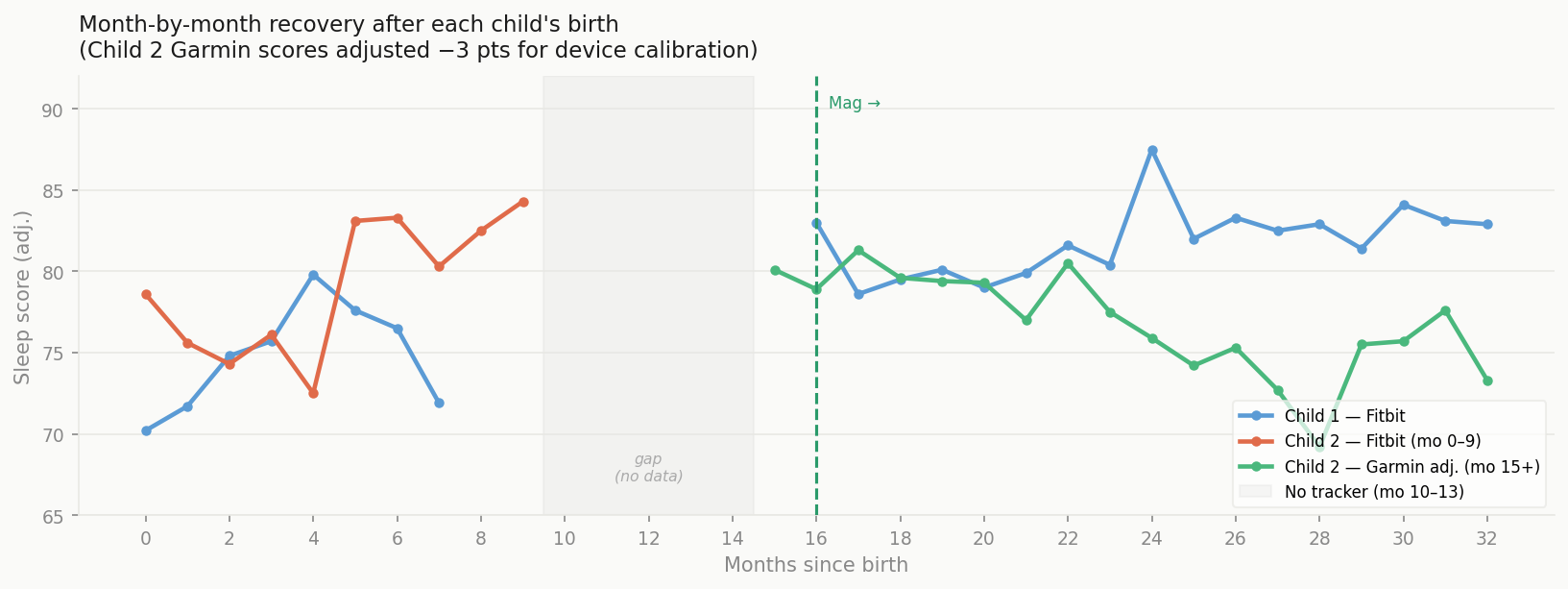
The chart above aligns both children by months since birth. Blue = Child 1 on Fitbit. Orange = Child 2 on Fitbit (months 0–9). Green = Child 2 on Garmin, adjusted down 3 points for device calibration (months 15+). The dashed green line marks when magnesium started (Child 2’s month 16). The grey shaded region is the data gap when I had no tracker (months 10–13).
A few things worth noting:
Child 2 (orange) tracked consistently above Child 1 (blue) in the newborn and infant months — less disruption, faster recovery.
At months 25–28 (roughly November 2025 – February 2026), scores on the Garmin dipped significantly — this lines up with the well-documented 2-year sleep regression.
The recovery from that dip is already visible by months 30–31.
The Magnesium Signal
So, does it work? The clearest answer is in the awake time data. Being woken up by a toddler isn’t the problem; it’s lying there unable to get back to sleep (sometimes multiple times per night!) that grinds you down.
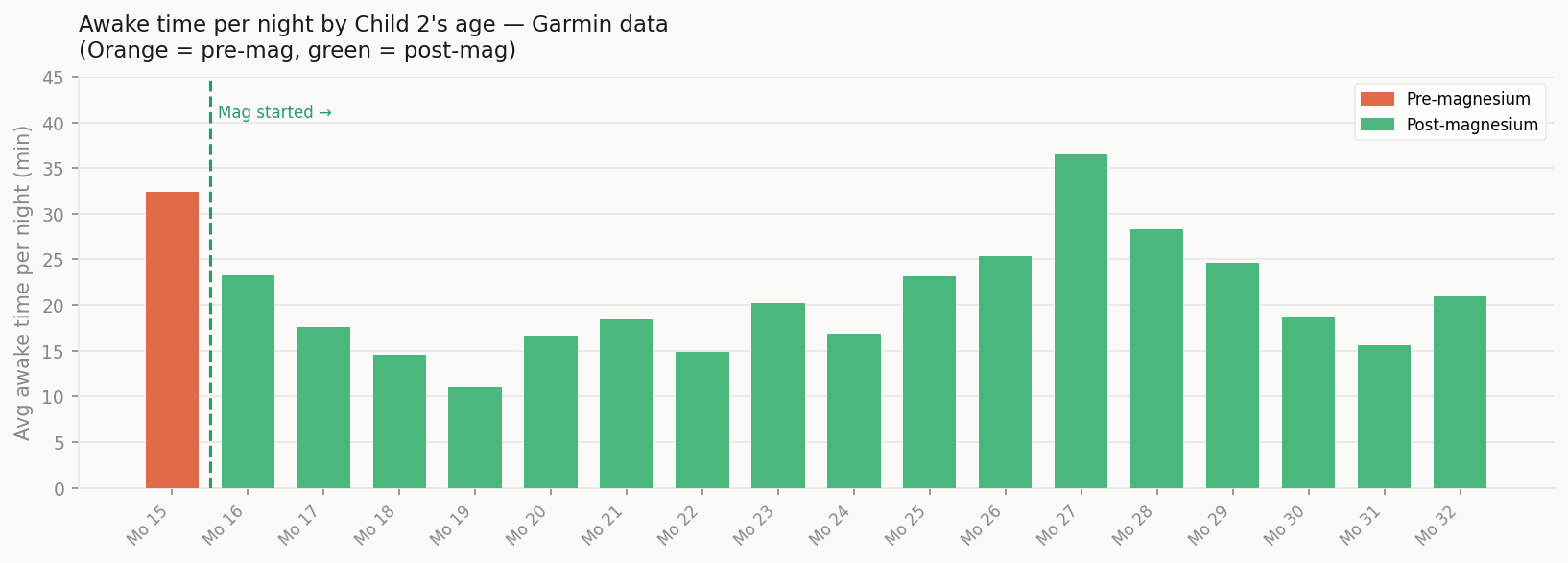
Before magnesium (months 15–16, shown in orange), my average awake time was 23–32 minutes per night. From month 17 onward — the first full month on mag — it dropped to 11–18 minutes and held there for six months. That’s not a small change.
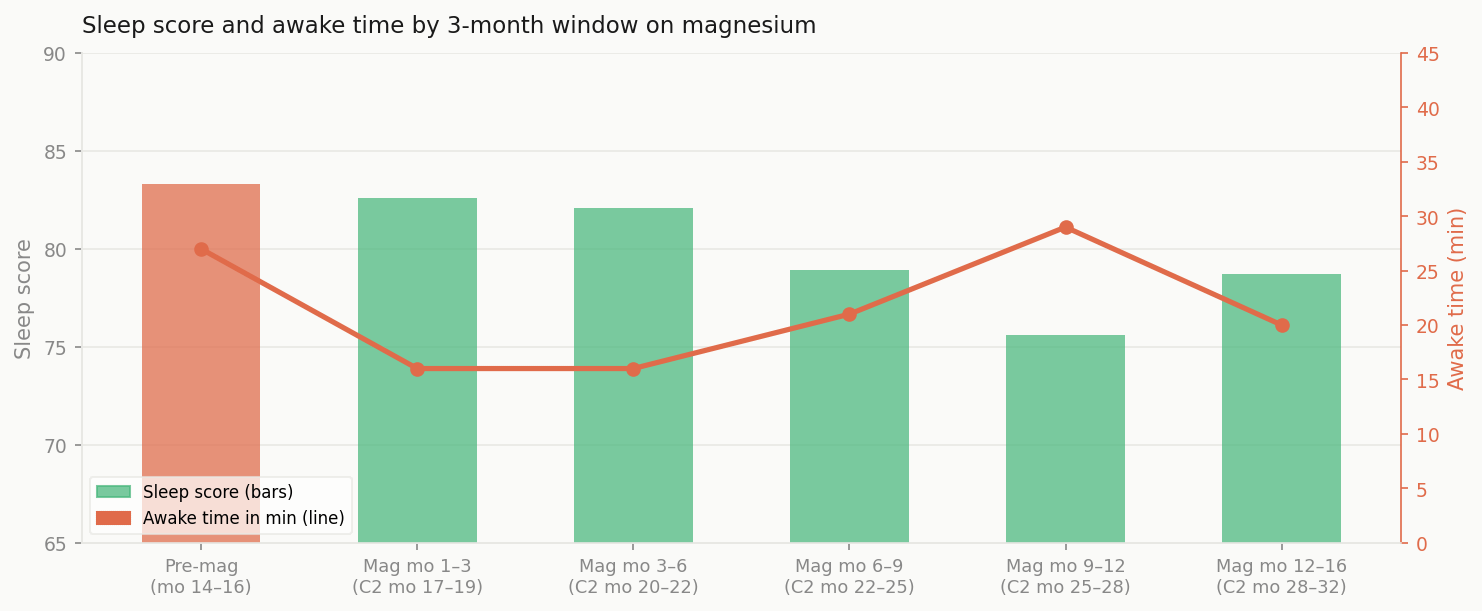
The bars show average sleep score and the orange line shows average awake time. The first three months on mag (Child 2 age 17–19 months) were the best stretch: awake time averaged 16 minutes per night, awakenings dropped to 1.0 per night (down from 1.6 before). Months 9–12 on mag were rougher — that’s the 2-year regression — but the score has since recovered and awake time is back to around 20 minutes.
The Statistical Picture
Running the numbers on pre-mag vs post-mag Garmin data (49 nights before, 478 nights after):
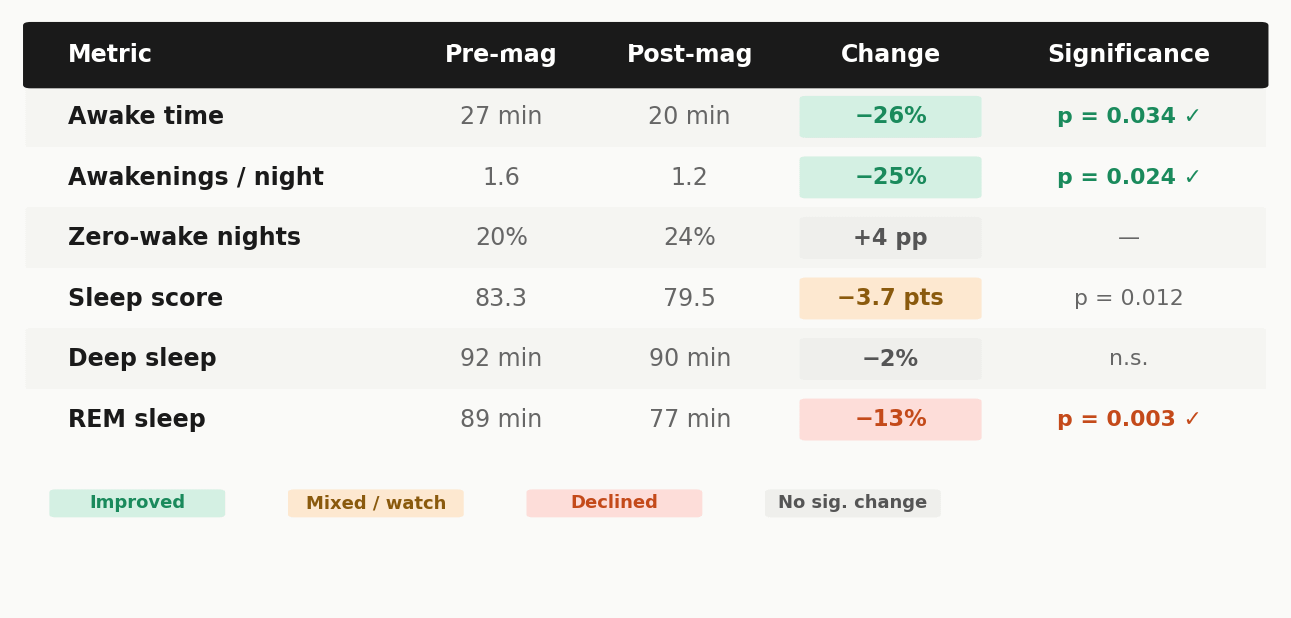
The awake time and awakening improvements are real and statistically significant. The overall score drop looks alarming at first glance but is almost certainly explained by seasonal patterns and the 2-year regression — my Fitbit shows the same Nov–Feb score dip in 2023 and 2024 without any infants involved.
The REM decline is the one thing I’m keeping an eye on. A 13% drop is meaningful. However, total sleep also dropped about 24 minutes per night, and REM tends to compress when total sleep time shrinks. My working theory is that this reflects toddler-era schedule constraints more than anything the magnesium is doing. I’ll revisit this once Child 2 fully settles into consistent sleep around the 3-year mark.
What This All Means
What Claude thinks: “The magnesium is probably helping. The awake time drop is too consistent and too sharp to dismiss. Getting back to sleep faster after a middle-of-the-night kid interruption is exactly the subjective benefit I was hoping for, and the data reflects it.”
What I think: With two kids and almost six years of constant, interrupted sleep, it’s tough to know for sure whether magnesium is helping. The awake time datapoint is promising but is that really the magnesium? I generally do wake up feeling well rested though! I’ll continue supplementation, especially because I’m curious to review the metrics once Child 2 sleeps through the night consistently.
Additional conclusions:
Child 2 was genuinely easier. This didn’t surprise me. On the same device, the same algorithm, at the same life stage, Child 2’s newborn months were 6 points better than Child 1’s. Partly due to more experience as parents and a better sleep temperament. But it means the improvement I see in the Garmin period isn’t purely from the supplement; some of it is just having an older, better-sleeping toddler.
The hard part is controlled experiments are impossible. I can’t run this twice. I don’t have a version of 2025 where I didn’t take magnesium. What I can say is that the awake time trend is directionally consistent with what I hoped the supplement would do, and it showed up right when I started taking it.
I’ll keep taking it. The cost is moderate, there’s no downside health risk, and the data supports a genuine benefit in the metric I care about most. I’ll do another analysis around the time Child 2 turns 3 — at that point the toddler noise should largely be gone, and any remaining signal will be cleaner.
Methods & Notes
Fitbit data: 1,198 nights, December 2019 – July 2024. Data source from a Google Health data export (Takeout → Google Health → Sleep Score → sleep_score.csv).
Garmin data: 527 nights, December 2024 – June 2026. Data source from Garmin data export (DI_CONNECT → DI-Connect-Wellness → various timestamped files ending in “sleepData.json.”)
Device calibration: Garmin scores adjusted −3 pts in head-to-head child comparisons based on observed offset between devices in stable periods
Statistical tests: Welch’s t-test for pre/post comparisons on Garmin data
Rolling averages: 30-day rolling means used in timeline charts
Limitations: No control condition; seasonal effects not fully isolated; short pre-mag baseline window (49 nights); REM decline warrants monitoring
Analysis done with Python (pandas, scipy, matplotlib). Charts generated from raw tracker exports.